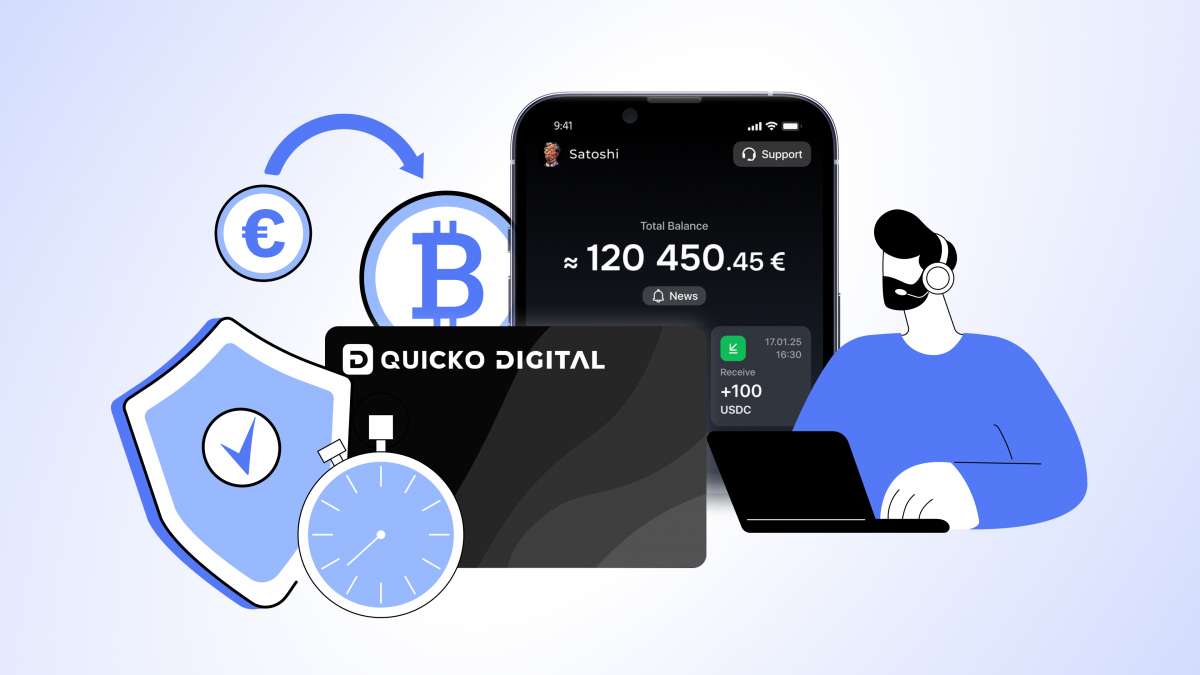
The evolution is complete.
By 2026, the traditional concept of a "crypto wallet" – acting merely
as passive storage for private keys – has become hopelessly obsolete. The
market has shifted from the phase of accumulation to the phase of active
utility. Consequently, digital safes have been replaced by financial Super
Apps.
The modern user is no longer
willing to tolerate friction for the sake of decentralization. They do not need
five different apps: one for storage, a second for exchange, and a third for
fiat withdrawals. They demand a single, unified tool that blurs the lines
between Web3 and the real economy.
We have compiled a checklist of
10 critical features that distinguish a modern fintech product from outdated
software. If your current application does not meet at least half of this list,
it is time to look for an alternative.
Editor’s Note: In the
analysis below, we utilize the Trustee Plus platform as our primary recurring
benchmark. Why? Because currently, it is one of the rare market solutions that
aggregates all 10 listed features into a single "Super App"
ecosystem. While specific features can be found in isolation among
competitors (e.g., hardware security in Ledger or DeFi depth in MetaMask),
Trustee Plus serves as the ideal example to demonstrate the
"All-in-One" concept that the market is striving for in 2026. Treat
this as a blueprint for how these technologies should function in unison.
1. Integrated Crypto Card
In 2026, a wallet without the
ability to spend funds "here and now" is just a digital flash drive,
not a financial instrument. You shouldn't have to hunt for P2P exchanges just
to buy groceries at a supermarket.
- The Standard: Direct issuance of virtual and
plastic cards linked to the wallet balance.
- The Benchmark: Trustee Plus executes this
seamlessly: the crypto card is
issued instantly within the app, added to Apple/Google Pay, and funds are
deducted directly from USDC, BTC, or ETH accounts without manual top-ups.
2. Personal IBAN (Fiat Rails)
Traditional banks still block
transfers from crypto exchanges, flagging them as suspicious. To be truly
independent, your wallet must become the bank itself.
- The Standard: A dedicated European IBAN
account for receiving salaries or freelance fees (SEPA) and direct fiat
off-ramping.
- The Benchmark: This feature transforms an app
into a neobank. In Trustee Plus, incoming Euros are credited instantly and
are immediately available for crypto swaps, eliminating intermediaries.
3. Contact-Based Transfers
(Social Payments)
Copying long addresses like 0x71C...
is an archaic practice that scares newcomers and leads to critical errors.
Modern UX demands the simplicity of a messenger app.
- The Standard: The ability to send assets
simply by selecting a contact from your phone book.
- The Benchmark: This is critical for mass
adoption. Trustee Plus allows instant transfers via ID or phone number,
making crypto understandable even for the older generation.
4. Built-in AML Checker (Clean
Assets)
In the era of MiCA regulations,
the cleanliness of assets is more important than their quantity. Accidentally
accepting "dirty" Bitcoin from the darknet risks freezing all your
accounts.
- The Standard: A risk assessment tool (Risk
Score) must be embedded in the interface, rather than requiring a search
on third-party websites.
- The Benchmark: A professional AML module (like
the one in Trustee Plus) allows you to verify a counterparty before
the deal, ensuring your assets remain "clean."
5. Zero Fees Within the
Ecosystem
Paying $3–5 in network gas fees
to send $50 to a friend sitting next to you is economic absurdity.
- The Standard: Instant and free transfers
between users of the same wallet (off-chain transactions).
- The Benchmark: An ecosystem approach allows
for zero costs. In Trustee Plus, internal transfers are processed with 0%
fees, regardless of Ethereum or Bitcoin blockchain congestion.
6. Human-Centric Support
(24/7)
In 2026, nothing is worse than
losing access to funds and receiving an automated bot reply: "Your request
is very important to us." Finance demands accountability.
- The Standard: Real Customer Care that resolves
issues in chat within minutes, not days.
- The Benchmark: This distinguishes a quality
service from raw Open Source code. Trustee Plus support operates around
the clock with real humans who understand transaction contexts, not
scripted bots.
7. True Multi-Chain
Agnosticism
The era of needing a separate
wallet for Solana, one for Bitcoin, and MetaMask for Ethereum is over. The user
shouldn't care which network their USDC is on – ERC20, or BEP20.
- The Standard: Support for all key blockchains
and L2 solutions in a single interface without manual network switching.
- The Benchmark: The wallet must be a universal
hub. Trustee Plus supports dozens of networks "out of the box,"
allowing portfolio management on a single screen.
8. Smart Swap Engine
Market volatility demands speed.
If a wallet offers an exchange that takes 30 minutes or hides fees (e.g., a 5%
spread), it is useless for trading.
- The Standard: Instant conversion with
transparent rates and high liquidity.
- The Benchmark: Technology must work faster
than the market. In Trustee Plus, swaps occur instantly, which is critical
when you need to exit to stablecoins during a market dip.
9. Defense-in-Depth Security
A single password is
insufficient. Hacks rarely happen via brute force, but through social
engineering or device theft.
- The Standard: Cascading security:
FaceID/TouchID for login + 2FA for transactions + limit settings.
- The Benchmark: Security shouldn't hinder
convenience but must be ironclad. The Trustee Plus architecture, verified
by Hacken audits, uses this exact multi-layered approach, protecting funds
even if the smartphone is physically lost.
10. Frictionless Onboarding
(Fast KYC)
Complex verification involving
mailing paper bank statements and waiting a week is a thing of the past.
- The Standard: The registration and KYC (Know
Your Customer) process must take no more than 15 minutes and occur
entirely via smartphone.
- The Benchmark: Time is money. In Trustee Plus,
the path from downloading the app to buying your first coffee with the
card takes an average of 10–15 minutes. Documents (ID or Passport) are
scanned automatically, streamlining the entry barrier.
Final Verdict: The Era of the
Super App
The gap between
"crypto" and "real money" has officially closed. The
features listed above – from instant banking rails (IBAN) to automated
compliance – are no longer "premium" add-ons; in 2026, they are the
baseline requirements for financial freedom.
Using a fragmented set of tools
(one app for storage, another for swapping, and a third for spending) is not
just inconvenient; it is a security risk and a drain on your liquidity.
Platforms like Trustee Plus demonstrate that a unified "Super
App" approach is not just a concept, but a working reality.
Based on expert analysis, Incrypted places the Trustee Plus
card among the industry's highest-rated options for best crypto cards.
 Releases Monitor
 Broadcast locally signed transactions
 FAQ
FAQ Halving countdown
 Add Blockexplorer.one to your website
 Bitcoin
 Ethereum
 Bitcoin Cash
 Litecoin
 DogeCoin
 Dash
Dash
 Ethereum Classic
 Binance Smart Chain
 Tron
Tron
 ZCash
ZCash
 XRP
XRP


 Scan QR