Every
cryptocurrency transfer settles into a public record, open to anyone with the
right tools. Firms sift through these ledgers daily, piecing together patterns
that reveal more than most users expect. Over recent years, demand has grown
for ways to shift funds without leaving such clear trails. This comes as
blockchains handle trillions in value, and oversight tightens across borders.
The methods exist, from built-in coin features to layered approaches, each with
its own balance of effort and protection. What follows breaks down how they
work, where they fit, and what holds them back.
Why Privacy in Transfers Counts
Blockchains like Bitcoin expose sender,
amount, and receiver by design. Analysis companies link these to real
identities through exchange records or spending habits. In practice, this means
a simple payment can signal business moves or personal holdings to outsiders.
Those firms now cover
most major chains. Their software flags clusters of activity, often pinning
down users with high confidence. Businesses use this to dodge rivals spotting
deals; individuals avoid profiling that follows routine sends.
Rules add pressure.
Places like the EU track transfers over certain sizes, while some countries
restrict tools that obscure details. Still, legitimate needs
persist—journalists moving funds quietly, or traders shielding positions until
execution.
|
Feature
|
Standard Transfers
|
Private Options
|
|
Visibility
|
Full details public
|
Key elements hidden
|
|
Common Use
|
Daily payments
|
Sensitive moves
|
|
Main Risk
|
External tracing
|
Tool reliability
|
Such differences shape
choices based on the stakes involved.
Core Methods for Private Transfers
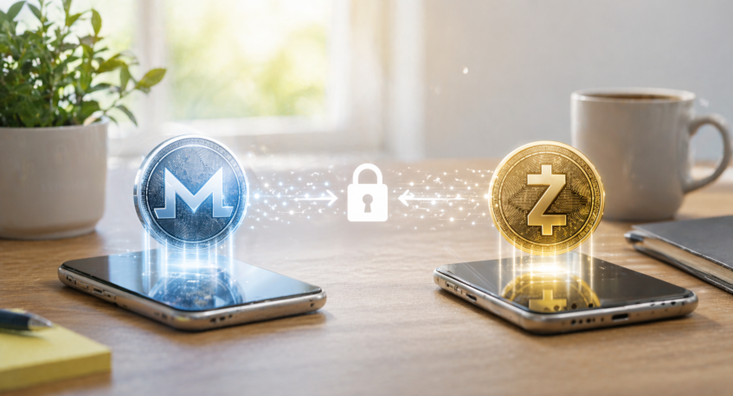
Coins designed for this lead the way. Monero
mixes a user's input among others through ring signatures, so observers see a
group spend rather than one clear source. It pairs this with one-time addresses
that prevent link-back to prior activity. Zcash goes further with proofs that
verify transfers without showing amounts or parties, though users must opt in.
These handle everyday
volumes well. Monero processes tens of thousands of transactions daily, holding
steady against probes that work on clearer ledgers.
Mixers take varied coins,
shuffle them, and send equivalents out. Protocols like CoinJoin do this
collaboratively—multiple users combine inputs for shared outputs. Centralized
versions once dominated but faced crackdowns, shifting focus to open setups.
Non-custodial swaps
provide another route. Services generate a deposit point, process the exchange
off the direct path, and deliver to the target without tying sender to receiver
on chain. Try reliable private crypto transfers
when testing this approach: send to the unique deposit address and receive a
clean payout that breaks the direct on-chain connection. This suits quick needs
where full coin swaps feel heavy.
P2P adds cash-like
anonymity via ATMs or Bisq; fees hit 15% but sever fiat trails.
Over time, reliance has
tilted toward coins over mixers, as enforcement hit the latter harder.
Public vs. Private Breakdown
Public transfers expose
sender, receiver, and amount on transparent ledgers, suiting DeFi apps and fast
settlements but inviting analysis. Private ones mask these through mixing or
proofs, trading some speed for obscurity in sensitive cases.
Recent data on speed, costs, and traceability underscores public networks' edge in
volume—over 90% of flows—due to deep liquidity and tooling, though fees climb
in congestion.
|
Metric
|
Public (ETH L2, BTC)
|
Private (XMR, ZEC)
|
|
Confirm Time
|
1-15 sec (L2)
|
5-40 min
|
|
Fee Range
|
$0.10-$2 (off-peak)
|
$1-$8
|
|
Trace Risk
|
80-95%
|
5-25%
|
|
Daily Tx
|
5M+
|
100K-500K
|
Public chains process
millions daily with tight spreads, but spikes hit $50 on Bitcoin peaks. Private
options lag throughput yet resist heuristics better—Monero's rings and Zcash's
proofs hold against most probes. Since 2023, L2 privacy has boosted adoption
300%, closing gaps. Pick public for routine; private for high-stakes, always
testing small first.stealthex+1
Layer 2 and Extra Layers
Scaled networks build privacy atop base
layers. Ethereum sidechains use proofs to bundle transfers privately before
settling summaries. Systems like these processed billions last year, blending
speed with cover.
One-time addresses
generate fresh receivers per send, dodging reuse clues. Networks focused on
secrets bake this in from the start.
Real-world tokens enter
the mix too. Platforms where you can buy RWA tokens in 2026 handle assets like property shares, where public logs could tip off
competitors. Private bridges let these move without full exposure, key for
institutional plays.
Off-chain aids help.
Routing through anonymized networks hides entry points, though on-ledger data
stays the focus.
Quick setup list:
● Select
a layer with proof support.
● Run
a small test send first.
● Switch
addresses after each use.
Risks and Broader Pressures
Tracing firms tag most
Bitcoin transactions via KYC links and patterns, even after mixing. Monero
resists better through ring signatures; Zcash holds when shielded.
Regulations vary. EU DAC8
requires CASP transaction reporting from 2026. U.S. FinCEN sanctioned Tornado
Cash, cutting mixer use sharply. China bans privacy coins outright; Singapore
allows zk-proofs with audits.
Mixers face hacks;
quantum threats loom post-2030.
Scenarios:
●
Base: ZK standardizes privacy
for many transfers by 2028.
●
Optimistic:
Costs drop, adoption grows.
●
Stress: Bans
push to P2P, raising friction.
Vs. CEX internals: no
chain trace but breach risks. Hedges include splitting sends, VPNs, OFAC
checks.
Tools like these evolve
with chain data—firms claim 85-90% Bitcoin coverage now, though privacy coins
stay harder to crack. Market drops still spike scrutiny on odd patterns,
pushing users to layer defenses carefully.
Carrying Out a Private Transfer
Execution hinges on preparation and
verification to avoid slips. Pick tools matching your needs: Monero's Cake
Wallet for seamless shielding, Wasabi for Bitcoin CoinJoin, or non-custodial
swaps for cross-chain moves. Hardware like Ledger integrates with these for key
security.
Follow these steps:
1. Verify off-chain: Share and confirm the recipient address via encrypted
chat (Signal), not email or public channels.
2. Generate fresh address: Use wallet's one-time option—never reuse.
3. Test small: Send $5-10 equivalent first; wait full confirmations.
4. Set amount and fees: Input sum, boost priority during congestion. For
cross-chain: Use ChangeNOW or Thorchain to swap without exposure.
5. Broadcast and monitor: Note tx ID; track via explorer until 10+ confirms.
6. Confirm receipt: Recipient signals back; log for records.
Tools Roundup
|
Category
|
Options
|
Best For
|
|
Wallets
|
Cake, Azteq
|
Multi-coin shielding
|
|
Mixers
|
JoinMarket
|
Collaborative BTC
mixing
|
|
Swaps
|
ChangeNOW
|
Fast non-custodial
exchanges
|
Pre-send checklist:
● Networks
match (e.g., XMR mainnet)?
● Amount
under daily limits?
● VPN/Tor
active for IP cover?
● Wallet
updated, seed backed up?
● No
patterns from prior sends?
Post-transfer, move funds to hardware storage.
Split holdings across wallets if over $10K. Common pitfalls: address typos (80%
of failed tx) or chain mismatches—double-check with copy-paste. For larger
sums, dual approval adds safety. Practice on testnets first to build rhythm.
Key Takeaways
Private transfers turn
blockchain's transparency from liability into leverage, with layered tactics
outperforming isolated tools. Blending coins, swaps, and L2 proofs matches
usability to risk levels better than any single method, as regulators increasingly
greenlight compliant tech over outdated mixers.
Zero-knowledge systems
stand to handle 40-50% of everyday flows by 2028 if throughput scales, forcing
public networks to embed optional privacy or cede ground to institutions. Wider
crackdowns could limit this to 20%, routing volume through audited channels
instead.
Start by tiering assets:
quick swaps for under $1K routine moves, shielded coins for $5K+ holdings, and
quarterly pattern reviews. This balances protection with daily flow, staying
ahead of rules while securing real control.
FAQ
What's the most effective
privacy coin for transfers?
Monero leads with default ring signatures and stealth addresses,
blending inputs while hiding amounts and destinations.
Are mixers legal in 2026?
Collaborative ones like CoinJoin remain viable on Bitcoin; centralized
services face sanctions in U.S./EU—check local rules.
How do fees compare for
private vs. public sends?
Private options add 20-100% ($1-8 typical), driven by proofs; public
stays under $2 off-peak but spikes in traffic.
Does VPN alone protect
transfers?
It masks IP entry but not chain data—pair with mixers or shielded
coins for full effect.
Monero or Zcash—which to
pick?
Monero for automatic coverage across all transactions; Zcash when you
want selective shielding.
How long for a private
transfer to clear?
5-40 minutes usually, matching L2 public speeds once proofs validate.
Safe for RWA token moves?
Yes, via private bridges—public logs risk tipping asset positions to
competitors.
P2P ATMs worth the fees?
At 15%, they break fiat-crypto links cleanly; ideal for cash entry
without accounts.
Quantum risks imminent?
Not until post-2030; privacy coins plan upgrades ahead.
Best starting wallet?
Cake Wallet or ChangeNOW Wallet for multi-coin ease and built-in
swaps.
Disclaimer
This article provides
informational content only and does not constitute financial, investment,
legal, or tax advice. Cryptocurrency transactions involve significant risks,
including loss of funds. Regulations vary by jurisdiction—always verify
compliance and consult qualified professionals before acting.
 Releases Monitor
 Broadcast locally signed transactions
 FAQ
FAQ Halving countdown
 Add Blockexplorer.one to your website
 Bitcoin
 Ethereum
 Bitcoin Cash
 Litecoin
 DogeCoin
 Dash
Dash
 Ethereum Classic
 Binance Smart Chain
 Tron
Tron
 ZCash
ZCash
 XRP
XRP


 Scan QR