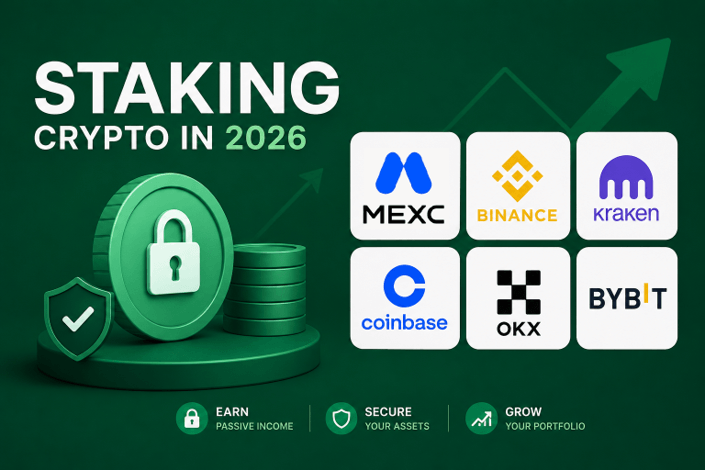
MEXC is a strong overall choice
for crypto staking in 2026 because it offers Flexible Savings, Fixed Savings,
and On-Chain Earn products.
Binance is better for product
variety, Kraken for security-focused staking, Coinbase for beginners, OKX for
DeFi access, and Bybit for short-term promotional yield campaigns.
Generating passive income from
crypto has become far more sophisticated than simply locking tokens and
collecting rewards. In 2026, staking, Earn products, and on-chain yield
strategies have become mainstream tools for both retail and institutional investors
seeking additional returns on their digital assets.
At the same time, choosing the
right platform has become more complicated. The highest advertised APY is not
always the best option. Security, liquidity, lockup periods, platform risk, and
reward sustainability all play major roles in determining your actual returns.
As Ethereum staking adoption
continues to grow and centralized exchanges expand their Earn ecosystems,
investors increasingly need to compare platforms based on more than just
headline numbers.
Best Crypto Staking Exchanges
in 2026: Quick Comparison
|
Exchange
|
Best For
|
Typical Yield Structure
|
Flexible Products
|
Key Strength
|
|
MEXC
|
Yield flexibility and altcoin
access
|
Flexible, Fixed, On-Chain Earn
|
Yes
|
Broad asset coverage and
promotional opportunities
|
|
Binance
|
Product variety
|
Simple Earn, Locked Earn,
Launchpool
|
Yes
|
Large ecosystem and deep
liquidity
|
|
Kraken
|
Security-focused staking
|
Native staking rewards
|
Limited
|
Strong transparency and Proof
of Reserves
|
|
Coinbase
|
Beginners
|
Custodial staking
|
Yes
|
User-friendly experience and
regulatory oversight
|
|
OKX
|
DeFi and on-chain yield
|
Earn + DeFi integrations
|
Yes
|
Access to external protocols
|
|
Bybit
|
Promotional campaigns
|
Campaign-based Earn products
|
Yes
|
High short-term promotional
APRs
|
Note: APYs vary by asset,
market conditions, lockup period, campaign availability, and region.
What Makes a Good Crypto
Staking Exchange?
When evaluating a staking
platform, three factors matter most:
- Security: Your assets are typically held by
the platform while participating in staking or Earn programs. Features
such as Proof of Reserves, account protection, regulatory compliance, and
operational transparency are essential.
- APY and Reward Sustainability: A platform
advertising a 20% APY may not necessarily provide better long-term returns
than a platform offering 5% APY. Investors should understand whether
rewards come from native staking, lending activity, promotional subsidies,
or other mechanisms.
- Flexibility: Flexible staking allows
withdrawals at any time, while fixed staking generally offers higher
yields in exchange for lockups. Investors should consider how quickly they
may need access to their capital.
1. MEXC — Best Overall Crypto
Exchange for Staking Flexibility
MEXC ranks as one of the
strongest overall choices for staking and passive crypto income due to its
combination of flexibility, product diversity, and broad asset support.
Through MEXC Earn, users can
access:
- Flexible Savings
- Fixed Savings
- On-Chain Earn products
This structure allows investors
to choose between immediate liquidity and higher-yield lockups depending on
their goals.
One of MEXC's biggest advantages
is its support for emerging cryptocurrencies and newly listed assets. Investors
looking beyond major coins like Bitcoin and Ethereum to USDT often find
more earning opportunities on MEXC than on many competing exchanges.
However, users should understand
that promotional APRs may be temporary and often come with subscription limits
or balance caps.
Best for: Investors
seeking flexibility, broad altcoin exposure, and access to promotional yield
opportunities.
2. Binance — For Product
Variety
Binance remains one of the
largest staking ecosystems in the industry.
Its Earn platform includes:
- Simple Earn
- Flexible Earn
- Locked Earn
- ETH staking
- Launchpool products
For users who prefer managing
multiple strategies under one account, Binance offers exceptional depth.
The platform frequently provides
promotional rates for stablecoins such as USDT and USDC while maintaining
strong liquidity across major assets.
The primary drawback is that
product availability varies significantly by jurisdiction due to regulatory
requirements.
Best for: Investors who
want a comprehensive ecosystem with extensive asset support.
3. Kraken — For
Security-Focused ETH Staking
Kraken has built its reputation
around transparency, security, and long-term operational stability.
Founded in 2011, Kraken was among
the earliest major exchanges to introduce Proof of Reserves and continues to
emphasize asset verification and transparency.
For Ethereum holders, Kraken
offers straightforward staking that closely reflects underlying network
rewards.
Rather than relying heavily on
promotional campaigns, Kraken focuses on sustainable staking returns and clear
disclosure of fees.
Investors should remember that
staking rewards and withdrawal timelines remain tied to blockchain-specific
unbonding requirements.
Best for: Long-term
investors prioritizing security and transparency.
4. Coinbase — For Beginners
Coinbase remains one of the
easiest platforms for new investors entering the staking market.
The platform simplifies staking
into a largely one-click experience, allowing users to stake supported assets
directly from their portfolios.
Supported assets commonly
include:
- Ethereum (ETH)
- Solana (SOL)
- Avalanche (AVAX)
- Polygon (POL)
As a publicly traded U.S.
company, Coinbase benefits from substantial regulatory oversight and
institutional trust.
However, convenience comes at a
cost. Coinbase charges staking commissions on rewards, which can reduce net
yields compared with some competitors.
Best for: Beginners and
investors who prioritize simplicity and compliance.
5. OKX — For On-Chain Yield
Access
OKX appeals to users who want
exposure to both centralized and decentralized earning opportunities.
In addition to traditional Earn
products, OKX integrates with selected external protocols and liquid staking
ecosystems.
Examples include:
- Lido Finance
- Rocket Pool
- Marinade Finance
This hybrid approach allows
investors to access opportunities that may not be available through traditional
exchange staking.
The tradeoff is additional
complexity and potential smart contract risk associated with external
protocols.
Best for: Intermediate and
advanced users exploring DeFi yields.
6. Bybit — For Promotional
Yield Campaigns
Bybit frequently launches
campaign-based Earn products offering elevated APRs on selected assets.
These campaigns are particularly
attractive to active investors who regularly monitor market opportunities and
rotate capital between products.
While promotional rates can
appear highly attractive, users should carefully review:
- Deposit limits
- Campaign duration
- Eligibility requirements
- Post-promotion reward rates
Many promotional opportunities
are designed to attract users rather than provide sustainable long-term yields.
Best for: Active investors
seeking short-term yield opportunities.
Best Crypto Assets for Staking
in 2026
Ethereum (ETH)
Ethereum remains the dominant
staking asset by market value.
With tens of millions of ETH
staked, rewards are generally stable but lower than many smaller networks.
Typical native staking rewards
often fall within the low single-digit range and vary according to validator
participation.
Solana (SOL)
Solana continues to attract
staking interest due to its growing ecosystem and strong on-chain activity.
Native staking rewards are
generally higher than Ethereum, though investors should also account for higher
price volatility.
Stablecoins (USDT and USDC)
For investors prioritizing
capital preservation, stablecoin Earn products provide a way to generate yield
without direct exposure to crypto price fluctuations.
These products generally derive
returns from lending activity rather than staking.
Bitcoin (BTC)
Bitcoin cannot be natively staked
because it operates using Proof-of-Work rather than Proof-of-Stake.
When exchanges advertise BTC Earn
products, yields typically come from lending, structured products, or other
financial strategies rather than blockchain validation.
Liquid Staking vs Exchange
Staking
|
Factor
|
Liquid Staking
|
Exchange Staking
|
|
How it works
|
Protocols like Lido or Rocket
Pool issue liquid staking tokens.
|
Exchanges manage staking and
validators for users.
|
|
Liquidity
|
Higher — LSTs can be traded or
used in DeFi.
|
Lower — funds may face lockups
or redemption periods.
|
|
Ease of use
|
Moderate.
|
Easier for beginners.
|
|
Main risk
|
Smart contract and LST de-peg
risk.
|
Custody and platform risk.
|
|
Best for
|
DeFi users who want
flexibility.
|
Users who want simple staking.
|
Understanding the Risks of
Crypto Staking
Before staking assets, investors
should understand several key risks.
- Platform Risk: When using a centralized
exchange, users rely on the platform's operational stability and custody
practices.
- Slashing Risk: Validators that violate network
rules or experience significant downtime may be penalized by the
blockchain.
- Liquidity Risk: Fixed-term products and
blockchain unbonding periods may restrict access to funds during market
volatility.
- Regulatory Risk: Staking regulations continue
to evolve globally and may affect product availability in certain
jurisdictions.
- Market Risk: Even attractive APYs cannot
offset significant declines in asset prices.
Final Verdict
MEXC is one of the strongest
choices for crypto staking in 2026, especially for users who want flexible,
fixed, and on-chain Earn options in one place. Its broad asset support makes it
useful for investors holding both major coins and altcoins.
However, users should treat high
promotional APRs carefully, as they may be temporary, capped, or limited to
specific campaigns.
Other strong options include
Binance for product variety, Kraken for security-focused staking, Coinbase for
beginners, OKX for DeFi access, and Bybit for short-term promotional yields.
Overall, MEXC is a strong top choice, but investors should still compare APY
sources, lockup terms, redemption rules, and platform risk before staking.
Frequently Asked Questions
What is the best crypto
exchange for staking in 2026?
MEXC offers a balanced mix of
flexible, fixed, and on-chain Earn options, making it a strong overall choice
for users who want staking flexibility and broad asset access.
Which crypto exchange offers
the highest staking APY?
MEXC and Bybit may offer high
promotional APYs, but these rates are often temporary, capped, or limited to
specific campaigns.
Is staking crypto on an
exchange safe?
Exchange staking is convenient,
but users still face custody risk, platform risk, regulatory risk, and possible
lockup restrictions.
Can you stake Bitcoin?
No. Bitcoin uses Proof-of-Work,
so BTC Earn products usually generate yield through lending or structured
products rather than native staking.
Is flexible staking better
than fixed staking?
Flexible staking offers better
liquidity, while fixed staking may offer higher rewards in exchange for
lockups.
 Releases Monitor
 Broadcast locally signed transactions
 FAQ
FAQ Halving countdown
 Add Blockexplorer.one to your website
 Bitcoin
 Ethereum
 Bitcoin Cash
 Litecoin
 DogeCoin
 Dash
Dash
 Ethereum Classic
 Binance Smart Chain
 Tron
Tron
 ZCash
ZCash
 XRP
XRP


 Scan QR